Concrete doesn't wait. Neither should your ERP.
Ready-mix concrete runs on a clock that most industries never have to think about. Once a batch is mixed, there is a limited window before it stops being usable. Every step from batching to delivery has to happen in close coordination, or the material itself becomes the cost of the delay.
That clock is what makes RMC ERP software its own category. It is not a variation of quarry ERP, and it is not a generic manufacturing tool. It is software built around time-critical production and delivery, which is what GrowBiz ERP for ready-mix concrete is designed to manage.
What makes RMC operations structurally different
An RMC plant is not simply processing and dispatching material. It produces something whose working life is measured in minutes to a couple of hours after mixing. That changes what the software has to do in three ways.
- Mix design must be accurate and repeatable. Consistent quality is not optional. It is the product.
- Batching must be coordinated with dispatch. A batch with no truck available starts losing usable time immediately.
- Delivery must be tracked closely. The plant needs to know, in real time, whether a transit mixer will reach site while the concrete is still workable.
A quarry can hold crushed stone on the yard for weeks. An RMC plant cannot hold its finished product at all. Our guide to quarry and crusher ERP software describes that sister category, and the contrast is useful.
What RMC ERP software is not
The individual pieces already exist elsewhere, so it helps to be clear.
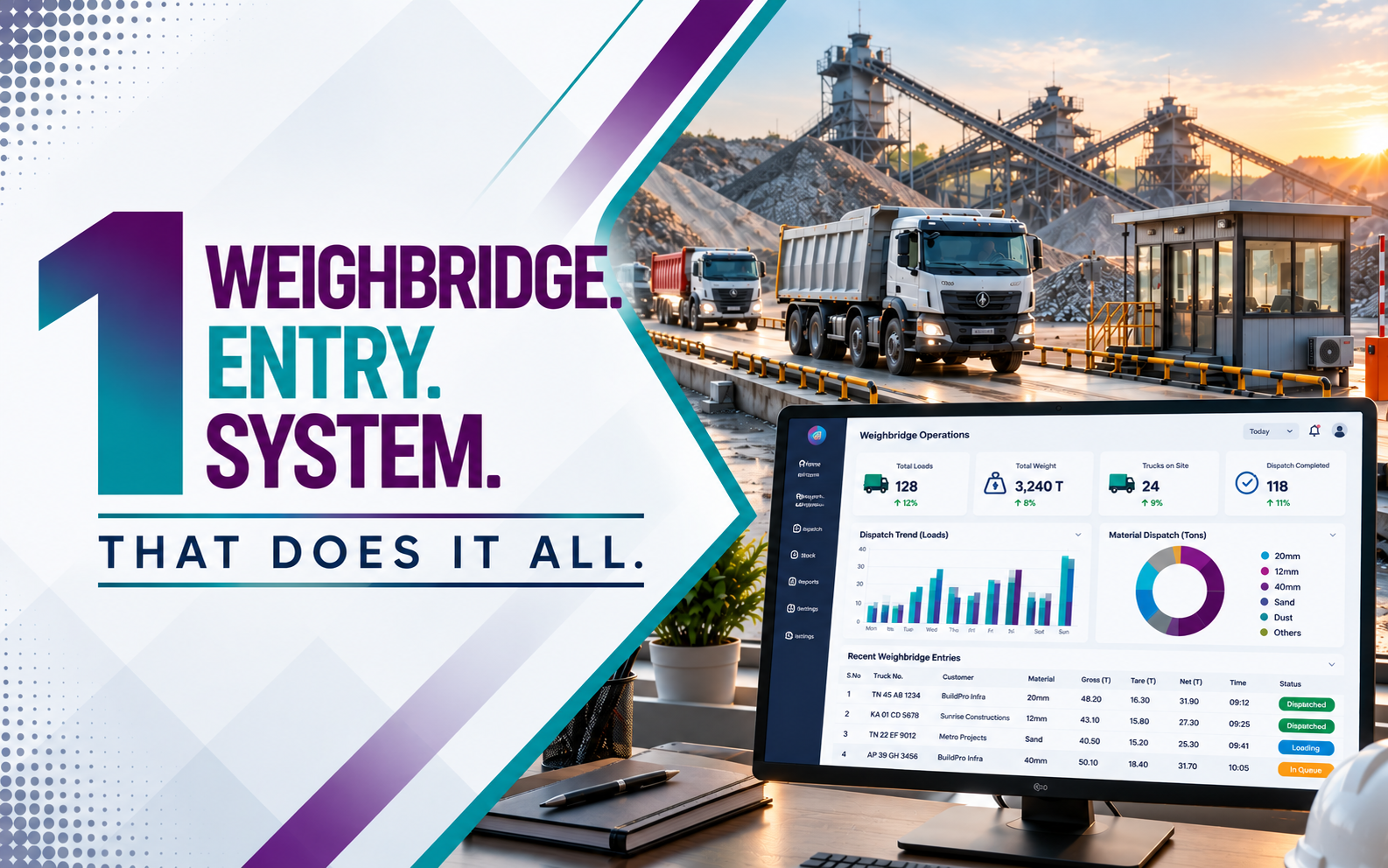
It is not just a weighbridge system. Weighing raw materials is part of the picture, but it is not the defining part.
It is not just dispatch software. Coordinating trucks matters, but concrete adds a time limit that generic dispatch tools were not built around.
It is not batching software bolted onto accounting. Mix design, quality and delivery timing have to be connected to each other. Managed as separate tools, they leave the gaps where most problems start.
We made the wider case in our article on why industry-specific ERP outperforms generic software.
The operational scope: order to billing
A genuine RMC ERP covers the full chain. The table shows what the system holds at each stage and what tends to go wrong without it.
|
Stage |
What the ERP holds |
What breaks without it |
|
Order booking |
Customer, site, grade, quantity and pour time |
Orders taken by phone and remembered, not scheduled |
|
Mix design |
Approved recipe for each grade |
The wrong recipe used, or an old version |
|
Production scheduling |
Batches planned against confirmed orders and trucks |
Concrete ready with no mixer to carry it |
|
Batching |
Actual quantities batched against the design |
No record of what went into a load |
|
Dispatch |
Transit mixer, driver, departure time and route |
The site calls to ask where the truck is |
|
Delivery |
Challan confirmed at site, with time and quantity |
Disputes over what arrived and when |
|
Billing |
Invoice raised from the confirmed delivery |
Invoices built from handwritten challans |
Raw materials and stock
Concrete is made from cement, sand, aggregates, water and admixtures. Each batch draws them down, so an RMC ERP tracks consumption as batches are produced. It does not wait for a month-end count.
Two ideas from our quarry content carry over directly. Incoming aggregate and cement loads still need to be weighed accurately, as we covered in our piece on weighbridge integration in ERP. The gap between book stock and physical stock opens up in the same way too, which our post on quarry stock and plant yield tracking explains.
If your business also runs its own quarry or crusher to supply aggregates, both operations can sit on one platform. See Quarry & Crusher ERP for that side.
Batching plant integration
The batching plant already knows what it produced. The question is whether that data stays inside the plant's control panel or reaches the rest of the business.
When the plant is connected to the ERP, the mix design is sent to the plant and the actual batched quantities come back against the order. Nobody retypes a batch sheet. Codelayer's integration services handle this connection, along with weighbridges and other site hardware. What can be linked depends on the make and age of your plant controller, so it is assessed site by site.
Quality records for every load
Quality in concrete is proven with records. An RMC ERP keeps the mix design used, the quantities actually batched and the delivery time against each load. When a contractor questions a pour weeks later, the plant can show what was produced and when it arrived. Without that link, the answer depends on someone finding the right batch sheet.
Transit mixers and the delivery window
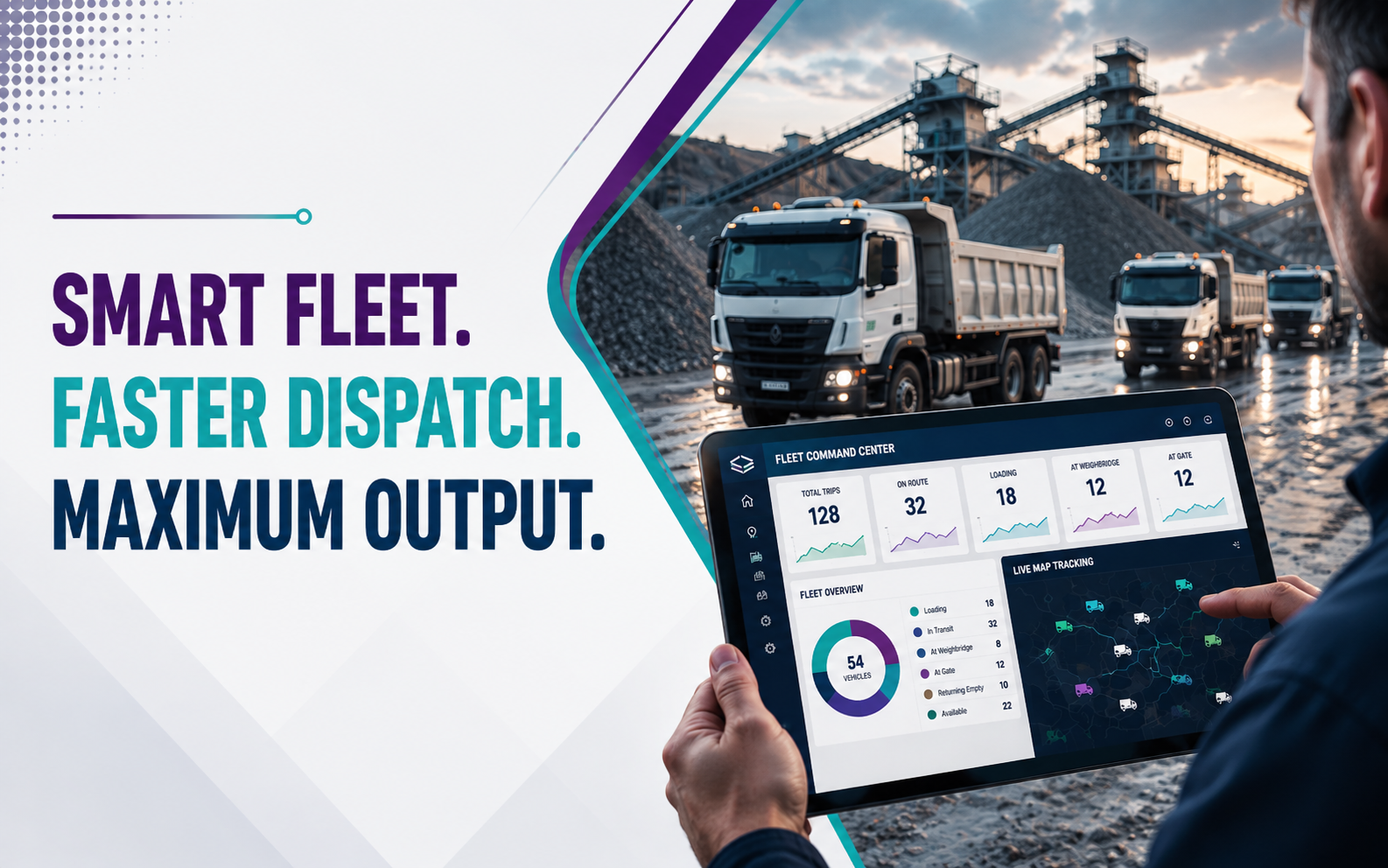
The turnaround thinking from our piece on fleet and dispatch management for quarry businesses applies even more sharply here. A quarry truck that waits loses time. A transit mixer that waits can lose the load.
An RMC ERP therefore tracks each mixer through its cycle: loading, in transit, at site, discharging and returning. Dispatchers see which vehicle is free before the next batch is released. The same vehicles also need fuel, trip and maintenance records, which is the role of fleet management and maintenance ERP.
Who this is for
This category is relevant whether you run one batching plant or coordinate several. Different people feel the problem differently.
- Plant owners and directors want to know that every cubic metre produced was delivered and billed.
- Plant managers are responsible for batching accuracy and consistent mixes.
- Dispatch and logistics heads need transit mixers on site on time, every time.
- Accounts and billing managers need invoices that match the delivery challan without a dispute.
Multi-plant operators have an added need. Orders, stock and mixers have to be visible across plants, so a load can move to whichever plant can serve the site in time.
Signs your plant needs it
- Contractors regularly dispute quantities or delivery times
- You cannot show what went into a specific load after the fact
- Dispatch runs on phone calls and memory
- You are adding a second or third plant
- A large client is asking for delivery records you cannot easily produce
One or two of these are normal. Several at once usually mean the tools have fallen behind the business. A plant with a few regular customers and low daily volume may not be there yet, and that is fine.
Where GrowBiz ERP fits in
GrowBiz ERP's RMC solution is built around this time-critical chain. It connects mix design, batching, dispatch, delivery and billing, so a plant is not racing the clock with separate tools that do not talk to each other.
Codelayer begins with a business analysis and consultation to understand how your plant runs today. Configuration follows that, not the other way round.
To see how it fits together, visit the Ready-Mix Concrete ERP page or request a demo. You can also explore the GrowBiz ERP ecosystem to see how it extends across quarry, brick manufacturing and the other industries Codelayer serves.