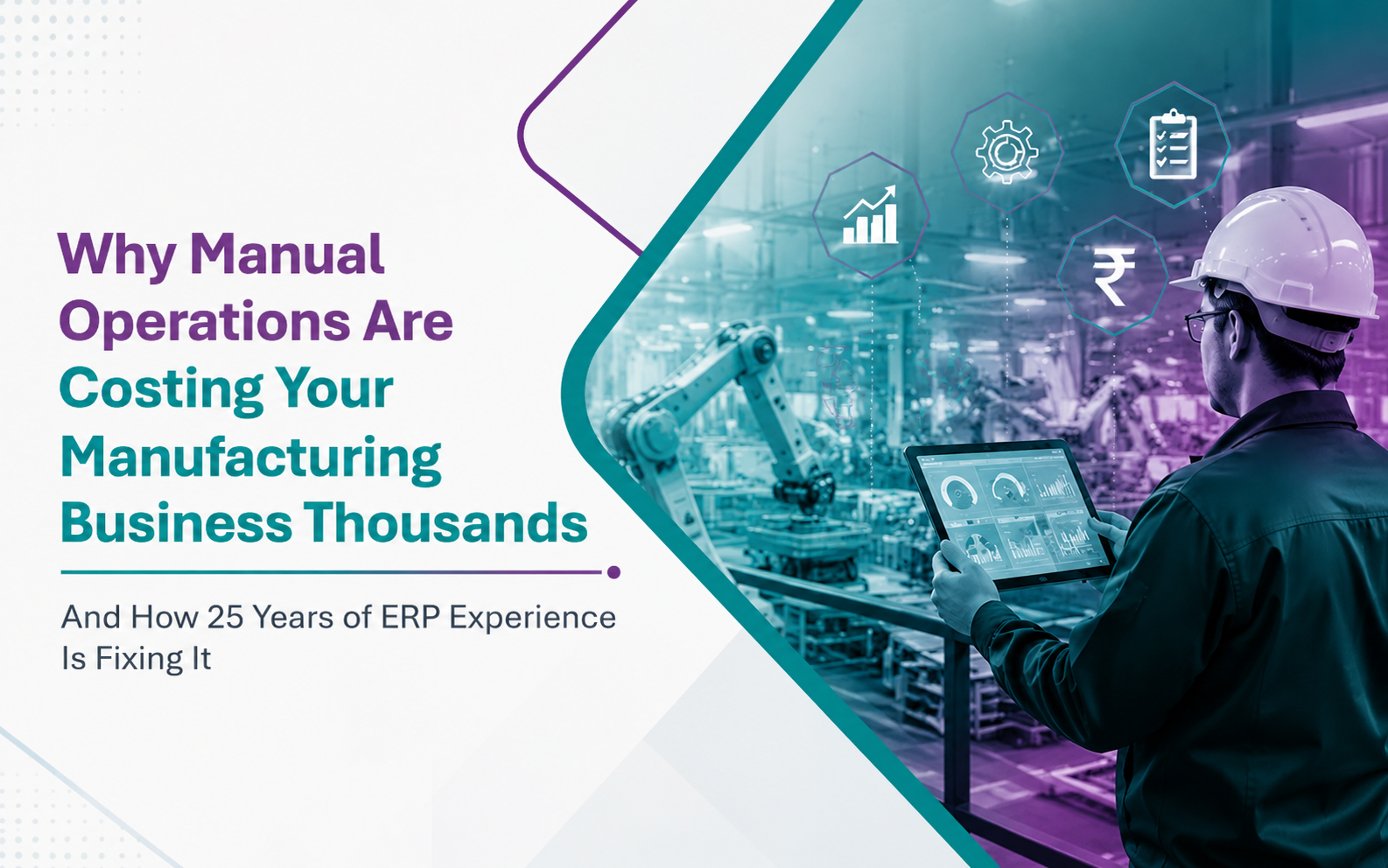
Why Manual Operations Are Costing Your Manufacturing Business Thousands
Picture a normal Tuesday morning at a mid-sized manufacturing unit. The production supervisor is on the shop floor with a clipboard, noting down output by hand. In the next room, someone in accounts is trying to reconcile yesterday's dispatch numbers against a delivery challan that was filled in by a different person, in different handwriting, with a different idea of what "complete" means. Down the hall, the owner is on a call with a client, trying to give a delivery date based on a stock count that is, charitably, an estimate.
None of this is dramatic. It's just Tuesday. And that's exactly the problem - because this kind of quiet, routine inefficiency rarely feels like an emergency. It just feels like work. But add it up over a month, a quarter, a year, and you start to see what it's actually costing.
If this sounds familiar, you are not alone, and you are not behind some industry curve that everyone else has already crossed. According to the EY India Manufacturing Report, 68% of Indian SME manufacturers still rely on manual or semi-digital processes. That's not a small, struggling minority. That's the majority of Indian manufacturing right now. The tools that were supposed to help - generic accounting software, scattered spreadsheets, WhatsApp groups standing in for proper communication - were simply never built for how a factory actually runs. 2iSolutions
This article is not a sales pitch. It's an honest look at what manual operations really cost a growing manufacturing business, why the shift to ERP has become less of a choice and more of a competitive necessity, and what separates an ERP implementation that actually works from the kind that becomes an expensive cautionary tale.
The Real Cost of Manual Operations (And Why It's Easy to Miss)
The trouble with manual inefficiency is that it almost never shows up as one big number on a balance sheet. It hides in dozens of small places, and each one looks too minor to fix on its own.
Time disappears into re-entry, not real work. Someone records production output on paper. Someone else types it into a spreadsheet. Someone else copies it into another spreadsheet for the owner's review. The same number gets handled three or four times before anyone actually uses it to make a decision. Multiply that across every department, every day, and you have skilled people spending hours on data entry instead of the work they were actually hired to do.
Manual processes create errors that compound. A misread handwriting sample on a stock register. A formula that breaks in a spreadsheet because someone added a row in the wrong place. A unit conversion mistake that goes unnoticed until a customer complains. None of these are catastrophic on their own. But they erode trust internally, between departments, and eventually with customers.
Visibility gaps delay every decision that depends on accurate, current information. If the owner has to wait until end of day, or end of week, to know how production is actually tracking against targets, every decision based on that information is already running behind. For many Indian manufacturers, core processes still run on a mix of legacy software and manual spreadsheets, which limits visibility and slows response to demand swings or supply disruptions. That delay is rarely visible in the moment. It shows up later, as a missed delivery date or a stockout nobody saw coming. Cybrosys
Compliance has become a moving target, and manual processes can't keep pace. GST compliance requirements in India have grown steadily more demanding since 2017, and the recent change is a clear example of how fast the ground can shift under a manufacturer's feet. In 2025-26, the e-invoicing threshold was lowered to Rs. 5 crore turnover, bringing thousands more manufacturers under its scope. If your invoicing and tax reporting still depend on someone manually checking rules and re-entering data, every regulatory update becomes a fire drill rather than a routine update. 2iSolutions
The honest, uncomfortable truth for a lot of manufacturing businesses is this: the inefficiency isn't a single visible wound. It's a slow leak. And slow leaks are the hardest kind to convince yourself are worth fixing - right up until the day you finally calculate what they've added up to.
Why the Ground Is Shifting Under Indian Manufacturing
Several forces are converging right now that make this a genuinely different moment than five or even three years ago.
India's manufacturing sector has crossed an important threshold. India's manufacturing GDP crossed $450 billion in 2025, making it the world's fifth-largest manufacturing economy, with an ambition to reach a trillion dollars by 2030. That kind of growth ambition cannot be built on whiteboards and end-of-shift paper reports. The vast majority of India's 63 million MSMEs still operate without real-time production visibility, relying on manual tracking and experience-based decision-making - and the gap between the factories that have moved past this stage and the ones that haven't is only going to widen. Cybrosys TechnologiesCybrosys Technologies
At the same time, digital infrastructure has become genuinely affordable for businesses that could never have justified an enterprise software budget a decade ago. The Indian market comprises around 60% of the SME companies who already adopted manufacturing ERP solutions, attributed to the availability of low-cost ERP solutions as well as a considerable number of skilled technical and functional talent. The "ERP is only for big companies" assumption simply isn't true anymore - and hasn't been for some time. Cybrosys Technologies
And the regulatory environment keeps adding pressure in the same direction. Tax compliance, traceability requirements, and reporting standards are not getting simpler. They're getting more specific, more frequent, and less forgiving of manual error.
Put together, this is why digital transformation has stopped being an optional upgrade for ambitious manufacturers and started being closer to table stakes for staying competitive at all.
What a Properly Implemented ERP System Actually Changes
It's worth being precise about what ERP does, because the term gets thrown around loosely enough that it's lost some of its meaning.
A working ERP system removes the repetitive, error-prone parts of data entry and reporting so your team's time goes toward decisions instead of re-typing numbers. It gives you a real-time view of production, inventory, and orders instead of a once-a-day or once-a-week snapshot that's already stale by the time anyone reads it. It builds compliance into the workflow itself, so a change like the lowered e-invoicing threshold becomes a configuration update rather than a scramble. And it does all of this in a way that's designed to scale - adding a new product line, a new location, or a new team shouldn't mean rebuilding your entire system of record from scratch.
The market data backs this up in ways that go beyond vendor marketing claims. SMEs that adopted ERP solutions saw increased operational efficiency of 20 to 25%, and in Western India's manufacturing clusters, manufacturers realized 20 to 30% improvement in operational visibility after adoption. One real example from the Indian market: after adopting Odoo ERP, a manufacturing unit reduced inventory losses by 38% and delivery delays by 23%. These aren't abstract industry averages dreamed up to sell software - they're the kind of outcome that comes from solving exactly the problems described above: re-entry, error, and delayed visibility. Cybrosys Technologies + 2
Here's the Part Most Articles Won't Tell You: Implementation Is Where Most ERP Projects Actually Fail
This is the section that matters more than any feature list, and it deserves to be said plainly rather than buried.
ERP, as a category of software, works. The data on that is not really in dispute. But buying ERP software and successfully implementing ERP software are two very different things, and the gap between them is enormous. According to Panorama Consulting Group's widely cited 2025 ERP Report, 73% of discrete manufacturing ERP projects fail to meet their objectives, with cost overruns averaging 215%. Gartner's research goes further, predicting that by 2027, more than 70% of recently implemented ERP initiatives will fail to fully achieve their original business goals.
The software isn't usually the problem. The implementation is.
This is why the choice of implementation partner matters as much as, or more than, the choice of software itself. The same research base offers a genuinely encouraging counterpoint: businesses that engage experienced implementation consultants see dramatically better outcomes. Organizations that engage experienced ERP consultants report an 85% success rate in their implementations, according to RubinBrown's research - compared to a failure rate of 55 to 75% across the broader market. That is not a small difference. That is the difference between an ERP project that transforms your operations and one that becomes an expensive story you tell new employees as a warning. Cybrosys Technologies
What separates the two outcomes, consistently, comes down to a few things: whether the implementation team actually understood your business before configuring the software, whether the system was customised to match how your industry genuinely operates rather than forcing your operations to bend toward generic software defaults, and whether your team was properly trained and supported through the transition rather than handed a login and a manual.
Where Codelayer Fits Into This Picture
We'll keep this section honest and short, because the point of this article isn't to sell you anything - it's to help you think clearly about a decision that genuinely matters for your business.
Codelayer Technologies has been delivering enterprise IT and ERP implementation work since 2000. Over that time, we've worked with more than 600 businesses across India and into 15 countries, and we hold official Odoo Channel Partner status, which means our implementation work follows Odoo's own recommended standards and practices rather than ad hoc workarounds.
What that experience has taught us, repeatedly, is exactly what the research above describes: the software is rarely the reason an ERP project fails. The reason is almost always that the implementation didn't reflect how the business actually operates. So our approach has never been to install a standard module set and walk away. We spend time understanding the specific operational reality of your business first - whether that's a quarry managing weighbridge dispatch, an RMC plant coordinating batching and delivery, a brick manufacturing unit tracking kiln cycles, or a general manufacturing operation managing multi-stage production. Then we configure, customise, train, and support around that reality.
We've specifically built deep expertise in manufacturing, quarry and crusher operations, ready-mix concrete, and brick production - industries with operational quirks that generic ERP implementations consistently get wrong. We've also seen businesses ranging from a few crore in turnover to well over fifty crore, which means we understand that what a growing MSME needs from an ERP system looks very different from what a larger, multi-site operation needs.
Key Takeaways
Manual operations don't usually fail loudly. They cost you quietly, in re-entry time, small errors, delayed decisions, and compliance scrambles that compound over months and years.
ERP adoption in Indian manufacturing has moved from "nice to have" to genuinely necessary, driven by GST compliance demands, the affordability of modern cloud ERP, and the scale of growth India's manufacturing sector is targeting.
The software itself is rarely what determines success or failure. Implementation quality is. The data is unambiguous: experienced implementation partners produce dramatically better outcomes than rushed or under-prepared projects.
Twenty-five years of implementation experience and 600-plus client relationships have taught Codelayer exactly where ERP projects typically go wrong - and how to avoid those failure points before they happen.
If you're at the stage of wondering whether your manufacturing operation has outgrown manual processes, the most useful next step isn't to buy software. It's to have an honest conversation about where your operation actually stands today.
Schedule a free consultation with our manufacturing ERP experts.